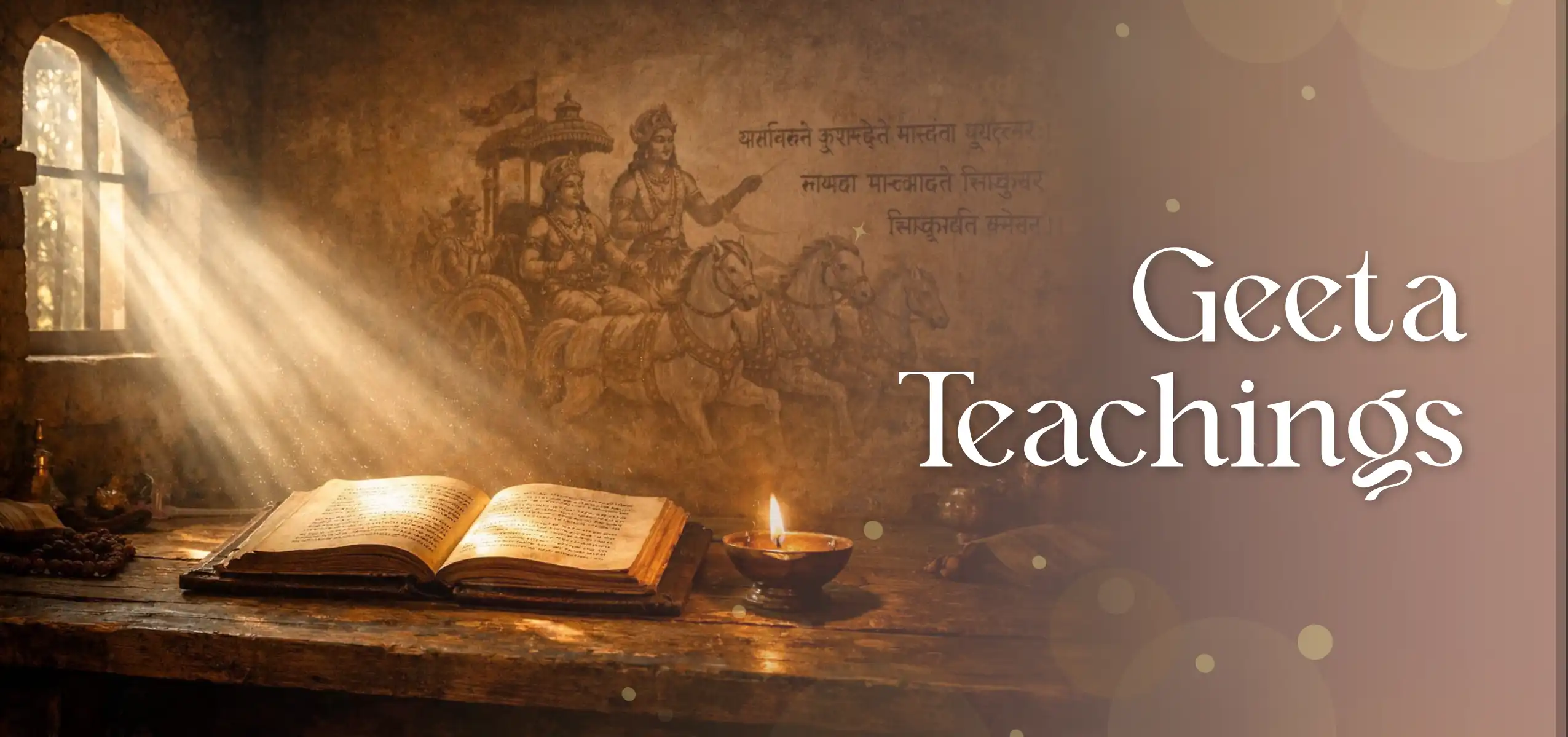
Bhagavad Gita – A Guiding Manual for Life and Liberation
The Bhagavad Gita, revered as the Gitopanishad is a crown Jewel of the golden history of Sanatana Dharma. The Gita contains 700 verses across 18 chapters (Adhyayas), offering practical guidance to live with clarity, strength, and spiritual balance. Of these, 574 verses are spoken by Lord Krishna, 84 by Arjuna, 41 by Sanjaya, and one by Dhritarashtra. Composed by Maharishi Ved Vyasa, the Gita stands as a universal manual for self-realization and right living.
The Bhagavad Gita is a timeless spiritual guide for all of humanity. Part of the great epic Mahabharata, this unfolds on the battlefield of Kurukshetra in the form of a dialogue between Lord Krishna and Arjuna. Beyond the war, it reflects the inner battle each human faces—between confusion and clarity, ego and wisdom, attachment and truth.
The Gita teaches that while the body perishes, the Atman (soul) is eternal. It encourages us to act without attachment, to serve without ego, and to surrender the fruits of action at the feet of the Divine. Through its synthesis of Karma Yoga (path of action), Jnana Yoga (path of knowledge), and Bhakti Yoga (path of devotion), the Gita unites action, wisdom, and love—guiding us toward liberation and inner harmony.
Each of its 18 chapters unfolds a unique dimension of awakening:
The Bhagavad Gita is not limited to monks or scholars—it is a manual for living consciously amidst worldly duties. Whether one is a student, householder, or seeker, its wisdom transforms confusion into clarity, fear into faith, and action into devotion.
Through its timeless light, the Gita awakens self-awareness, resilience, and spiritual strength—guiding us to rise above the noise of the world and discover the divine stillness within.
Benefits of the Bhagavad Gita Teachings
Reveals Dharma Clearly
Teaches how to walk the path of righteousness even amidst conflict and confusion.
Strengthens the Inner Self
Builds courage, detachment, and steadiness of mind in moments of doubt.
Awakens Higher Wisdom
Harmonizes Karma, Jnana, and Bhakti Yoga, making spirituality practical and complete.
Gives Freedom from Anxiety
Shifts focus from outcomes to sincere action, dissolving the bondage of results.
Connects with the Eternal
Awakens awareness of the Atman and deepens devotion to the Divine.
Transforms Daily Life
Makes every action—from work to worship—a step on the path to liberation (Moksha).
Rooted in the wisdom of the Upanishads, Vedanta, and the eternal vision of Sanatana Dharma, the Bhagavad Gita shines as a guiding light for all seekers. Through Gurumaa’s grace, this sacred scripture transforms from words on a page into a living experience—an inner awakening that turns ordinary life into a path of divine realization.
The Transformative Power of Gurumaa's Gita Guidance
Transform Inner Patterns
Replace limiting thoughts and habits with clarity, focus, and purpose.
Act with Wisdom
Apply Karma Yoga to make conscious, balanced choices without attachment to results.
Cultivate Emotional Resilience
Navigate stress, challenges, and uncertainty with inner calm.
Deepen Spiritual Connection
Evolve the heart through Bhakti Yoga and devotion.
Recognize the Eternal Self
Understand life beyond body, mind, and ego.
Integrate Wisdom into Daily Life
Harmonize personal, professional, and spiritual dimensions for holistic transformation.